The Cost of Clean Sneakers in Limón, CR
Before embarking on our journey to Limón, our guide Javier advised us to wear closed-toed shoes because we’d be trekking through muddy conditions in the banana and pineapple plantations along the way. Because of this I suited up in my star-studded cowgirl boots ready to embark on our muddy journey, assuming that others would come equally prepared.
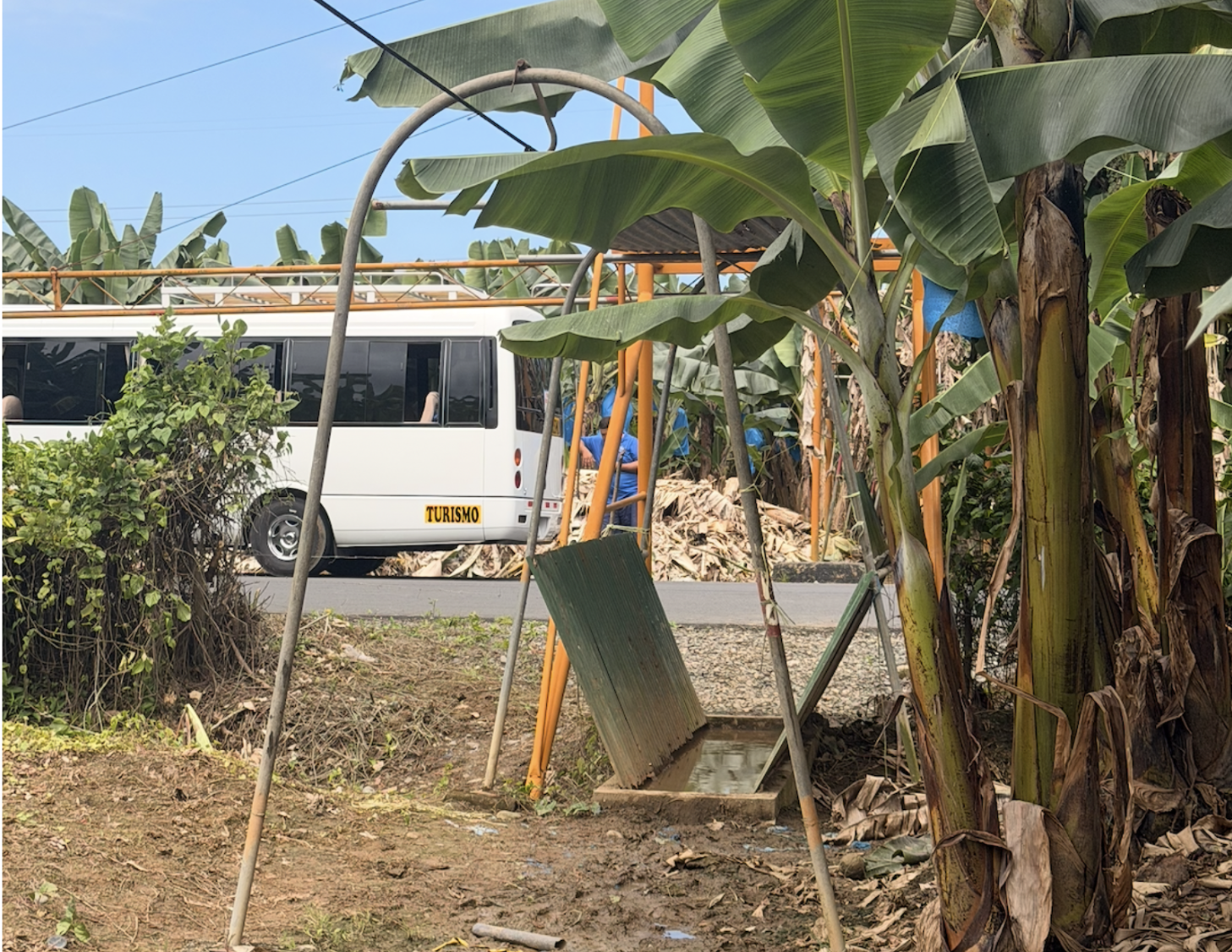
As we came across this receptacle filled with pesticide that would rid our feet of bacteria that could potentially ruin the local banana supply, I watched as a majority of the group ducked under the spiked gate to its right instead, a choice that I can only assume was made so as to not wet their nice sneakers.
Later on in the tour as Javier reminded them of the use of the vessel, I watched their faces fill with a sort of clueless guilt. At that moment I questioned how this group of ecologists, biologists, and self proclaimed environmentalists could be so unaware that they skipped over the grand entrance with a very obvious purpose, opting for a much more precarious path in the interest of their own momentary comfort. Coincidentally, that instinct to bypass responsibility because it feels inconvenient for an individual or organization mirrors the way Limón and its people have been treated for generations.
The greatest challenge that Limón faces today is not simply touristic negligence or economic underdevelopment, it is instead a lack of coherent, community-centered vision for growth, which quietly erodes the hope and potential of its children, and essentially its future. I argue that this is caused by the amalgamation of historical racial marginalization, extractive economic models such as plantations and ports, and a tourism industry that consumes culture without reinvesting in local futures.
A Crisis of Vision
The first interview I conducted with my partner Jeremiah was with the owner and bartender of Bar Tsunami, located just steps away from the entrance of our hotel. Though we never caught his name, he told us about his journey here as a Polish immigrant, the lack of profits and development in Limon, his wishes to return home, and ironically the 25 hectares of largely untouched land that he owned just 30 minutes to our north. Amongst his description of what he saw to be the largest disparities in his community there was an observation of his in particular that stood out to me.
“Where there is vision there is no money, where there is money there is no vision.”
He detailed multiple examples of stagnation and symbolic erasure that existed in the vicinity of his restaurant, citing vintage photographs hanging from the graffitied walls. Pointing out of the wide open door frame he confessed to us that the sewage processing facility that serves as his neighbor had once been a beach park, bustling with dancing people and music; that Marcus Garvey’s home had been destroyed and bulldozed instead of repurposed as a museum; that the incredibly scenic railroad from Limon to San Jose had been destroyed with the unfulfilled promise of a replacement; and that despite years of more unfulfilled promises of new development, the construction of the New Monseñor Sanabria Hospital remains stunted, leaving residents under the care of aging infrastructure.
While the Port of Moín which houses APM Terminals, a leading global port and terminal operator headquartered in The Netherlands represents a $1.1 billion investment in global commerce, the surrounding city watches as the large majority of that wealth glazes over the community that catalyzes its existence. Our bartender reported that last season, 168 cruise ships arrived at the port, yet due to a lack of employment opportunities in hospitality, there was no one present to guide the tourists out of their aquatic fortress and into the city center. Here the message is clear: the value of Limon lies in its convenience for transit, not its people or its existence as an explorable destination.
Amongst the detailing of the erasure of culture, the stagnance in development and the decline in public leisure like music or dancing, he fiercely warned us about going out at night, stating that there were virtually no bars or clubs open in the area past sunset. Let’s take a second to think about it. If a city has no nightlife, no free outlets for leisure, little public investment, a lack of cultural preservation, and very little economic pipeline beyond plantations and ports, what future could its young people imagine?
Root Causes
As discussed in Block 1, the struggle of Limon is inextricably linked to its identity and operation as a Caribbean plantation economy, a model designed to extract value (bananas, pineapples, and port fees), often leaving behind environmental degradation. For example, Costa Rica is one of the world's largest consumers of pesticides per hectare in its cultivation of pineapples. These chemicals protect the export crop similar to the pesticide bath, but the long-term health of the soil and the local water supply is rarely the priority of the exporter or the consumer. This parasitic relationship has been called out by many including a street vendor who sold us $2 bracelets while showing us the leg injury he survived while loading containers on the port.
“They use our culture [and products] to attract you to the country but give us nothing in return.” - Bernyl
Extractive systems like this one teach communities that their land is valuable only when exported, and is undeserving of nurture. The pesticide bath at the entrance of the banana plantation exists because a single bacterium could devastate one of the region’s primary exports. Though at this moment we are speaking of bananas, this economic sensitivity is prevalent in many sectors. And each risks collapse when the system is treated carelessly, or avoided totally by those who do not bear its consequences. In the process of constructing a nation and its identity, who is allowed to benefit, and who exactly suffers the butt of the consequences?
Alongside its history of extractive economics, Limon has a dark history of racial marginalization against its Black and Indigenous citizens, as many countries do. Afro-descendant communities have long been excluded from representation as Costa Ricans, only being constitutionally recognized in 2015, a detail I picked up from the charla with Dr Carmen Hutchinson before leaving for our trip. In addition, Indigenous communities have struggled for decades in their fight for food sovereignty and communal autonomy. As we saw during our visit to the Bri Bri community, they've been forced to adjust, commercializing their ways of living as a tourist attraction that somehow pays the bills. "Whiteness" in Costa Rica has historically been centered in the Central Valley, leaving the Afro-descendant and Indigenous populations of the Caribbean coast as the others, while their cultures are used as a lure for tourism. This sort of cultural and sometimes linguistic imperialism, has also been perpetuated by touristic groups and even educational programs like ICADS, where presenters like the Calypso musician from the Casa de Cultura are pressured to speak English for the comfort of a tourist, despite expressing uncomfortable feelings with their ability in the language.
The parasitic and extractive nature of tourism in Limon is simply a mimic of its plantation economy.
Visitors consume the culture and export the experience, be it to social media or through souvenirs, while offering minimal reinvestment and engaging in clueless neglect that could end in economic collapse. Such seemingly small decisions reflect how global consumers often remain detached from the fragility of export-dependent economies, all in the name of keeping their shoes dry. In the same way that corporations avoid tariffs, taxes, and reinvestment in local communities, all in the name of keeping their pockets full.
Just as my classmates ducked under the spiked gate, tourism and commerce often duck under the harder work of reinvestment and accountability. Visitors and corporations consume Limón’s beaches, culture, and labor, yet step around the uncomfortable work of understanding history or supporting long-term growth. This in turn promotes performative activism, short-term virtue, and personal comfort over meaningful engagement. Well-intentioned volunteerism and experiential tourism can easily become centered more on the visitor’s emotional experience than on sustained structural engagement. In this way we end up with turtle rescue tourists who end up going for a swim before the job is done, young American girls crying over the opportunity to eat a banana covered in cacao, and a boat full of tourists who were so easily pranked into believing that they had to give away valuable sentimental jewelry in order to enter into the sacred tribal land of the Bri Bri, a population they’d probably not done too much research about.
With this I beg the question; if development is shaped around pleasing visitors, and keeping their sneakers dry, what happens then to the internal imagination of local youth? Well, when the system is organized around external satisfaction, these young people learn that their role is either to serve, to leave, or to disappear. They are not invited to imagine themselves as architects of the future, only as caretakers of someone else’s experience.
Reimagining the Horizon
The pesticide bath at the banana plantation was designed to protect the future of a crop; community-centered development is designed to protect the future of a people. Both are undermined when comfort overrides responsibility and the most affected in these cases are often the leaders of tomorrow. The stark reality of Limón’s economic struggles produces a bifurcated childhood: one belonging to the tourist, marked by fine dining, surf lessons, and effortless mobility; the other belonging to the local child, often seen selling lollipops, working alongside their parents or hurling rocks at visitors like Jeremiah and I; a visceral expression of territorial frustration that, for a moment, I completely understood.
How could I be upset at the children throwing rocks at the people staring them down in the dark? Acts of frustration become expressions of territorial tension in spaces shaped by economic disparity and visibility without inclusion. Besides, what systems are shaping their options? If the only economic pipelines lead to a call center, a banana field, or a shipping container, the "vision" is strangled at the root. When a region cannot articulate a future for its children, their energy turns inward, outward, or nowhere at all. However, I propose that through investment in cultural preservation like the Garvey museum proposed by our bartender, youth-centered urban planning, reinvestment of commercial revenue, and educational pipelines beyond service labor, the horizon for youth in Limon could be extremely broadened. If vision and investment ever meet, there will be life again.
Conclusion
At the plantation, the entrance was clearly marked. The purpose of the pesticide bath was implied. The responsibility was simple. Yet many chose the drier path anyway, not noting its possible impacts. Limón’s history reflects a similar pattern: the path of responsibility has always been visible, yet tico and foreign profiteers alike repeatedly choose the route of convenience. The unfortunate reality is that in Limón, the consequences are not simply muddy sneakers but instead they are intergenerational burdens borne by the most innocent populations.
Limón does not lack talent, culture, or resilience. It lacks a development model that sees its children not as future laborers for ports and plantations, but as architects of their own community. Where vision and investment finally meet, hope will no longer feel like a tourist passing through. As Javier stated during his speech at the banana plantation
“nobody wants to feel uncomfortable in their patterns of consumption,”
but we all need to learn when it's time to put on our star-studded cowgirl boots and get muddy. Not as a fashion choice, but as a commitment to the reality of the terrain and as a show of respect for its seeds. If we as a society want to move beyond a development model that treats Limón as a Caribbean playground, we have to stop bypassing the uncomfortable gates.
We as a collective have to stop choosing the dry path of convenience, not for our own sense of virtue, but for the children of Limón whose futures depend on what we are willing to walk through.