The Social Life of Ephemera
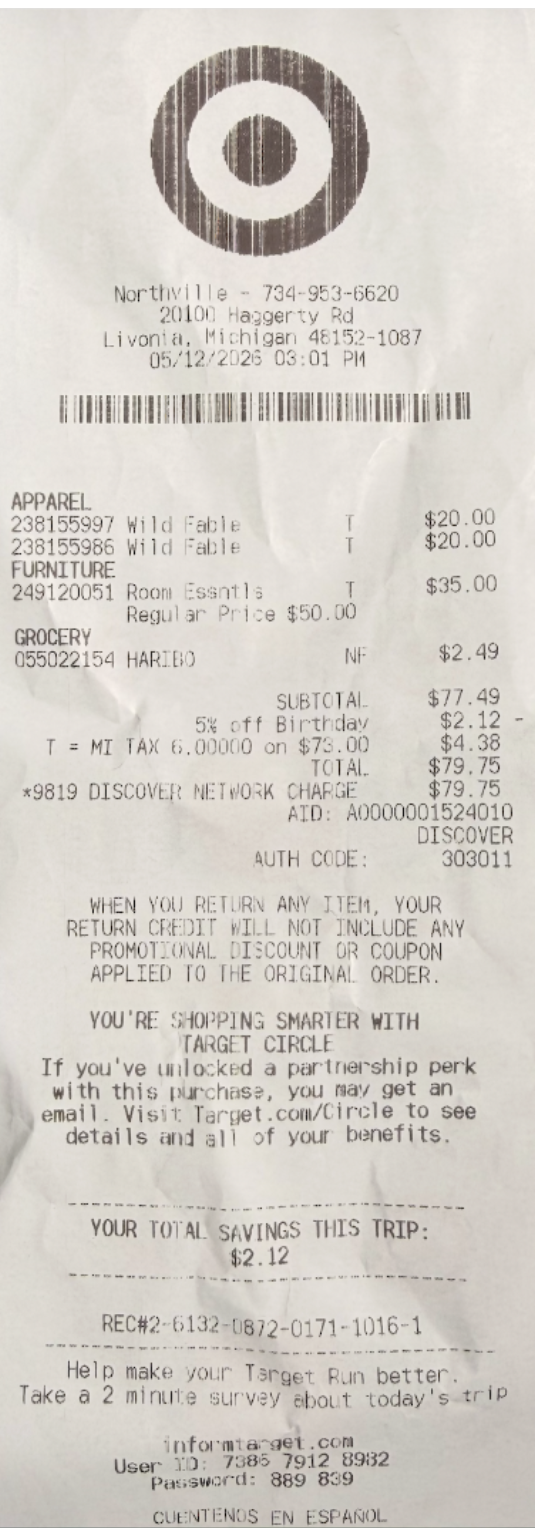
a target receipt for a bikini set and storage ottoman.
This is a receipt that I received from the self check-out machine during a recent trip to Target. It automatically printed after my payment was accepted and was dispensed right above a trash can filled with similar receipts.
Target stores give out these slips of paper as a summary or insurance of the products that they’ve sold to the receipt holder. The slip of paper records the date, time and location in which the purchase was made as well as itemizes the prices paid for each item purchased. Target in particular groups items by department such as “apparel” and “grocery”. It also includes return policies and the purchaser’s payment method in addition to a statistic on how much money they’ve saved during the visit. Near the bottom of the paper there is a link where visitors can leave a review about the quality of their experience in store. Finally the back of the receipt is covered in advertisements for Target’s credit rewards program or Target Circle.
There is a small trash can next to each checkout kiosk because most people tend to throw this item away upon receiving it. It is printed on relatively thin paper with thermal ink that fades quickly when agitated. However, it does serve limited purposes long-term. This receipt can be used as proof of purchase in the event that I’d like to return the bikini set or ottoman that I bought during this trip. This proof of purchase may also be requested while exiting the store to verify that all items purchased in self checkout have been scanned at the kiosk. Had I bought something for work or my business like a printer or ink, I could use this receipt as a tax write off.
The receipt demonstrates the social life of things because as illustrated in the last paragraph, its meaning changes depending on who possesses it and how it is used. In the hands of the customer, it acts as proof of purchase and a record of personal spending. For the corporation, it represents sales data and consumer behavior. For the government, it can become financial documentation connected to taxes or business expenses. If I were to fold the receipt into origami or use it for artwork, its significance would shift again from financial record to creative material. This shows how a single object can change meaning as it changes hands or contexts.
Though initially appearing insignificant, this slip of paper reflects broader systems of consumption and material culture in modern society. The receipt itself is a byproduct of consumerism created only due to the exchange of money for goods. Yet despite its temporary purpose it expresses materiality in that it can be held, folded, or lost. “Do you want your receipt printed or emailed?” is a growing question that now challenges the materiality of this form of record keeping as it removes the tangible object and replaces it with a digital mockup.
Additionally, a receipt carries symbolic meanings connected to wealth and value that can be revisited for the purpose of comparison or observation. The listed prices reflect what products were worth at a specific point in history. Future humans or archaeologists who examine this object might use those prices to understand inflation, standards of living, or patterns of consumption during our time period. Much like people today look at old menus or advertisements to compare historical prices, this receipt could become evidence of economic conditions and everyday life during this period. At the moment of purchase, the receipt functions as an active financial document. Over time, however, the thermal ink fades and the paper deteriorates, changing both its physical characteristics and its meaning.
In conclusion, the Target receipt demonstrates how even the most ordinary and disposable objects can carry complex social, cultural, and historical meanings. What is currently treated as disposable trash may later become a personal memory, financial evidence, or even a historical artifact. The object’s form, use, and significance are therefore not fixed but constantly shaped by cultural and social context. For me, the receipt represents proof that I purchased specific items and successfully completed a transaction. It also acts as a temporary form of security because I may need it later for returns, exchanges, or verification while leaving the store which may have important political implications in places that enforce laws against shop lifting. Since the receipt lists exactly what I bought, where I bought it, and when I bought it, it can also function as a small record of my personal habits, needs, and lifestyle at that moment in time. Looking back at it later could even trigger memories associated with the shopping trip itself, making it a nostalgic reminder and not just a slip of paper.