What does it take for technological capability to become useful progress?
If you had asked me a week ago, I would have told you that I mostly viewed modernization as a figurative bulldozer. One that would level the outdated work placed before it, leaving a blank slate for redevelopment in its path. My view was that a ‘modern’ system was one that consisted entirely of the newest, most optimized technologies. The underlying assumption being that, if the old system was no longer working, we of course needed a newer, and presumably more efficient replacement.
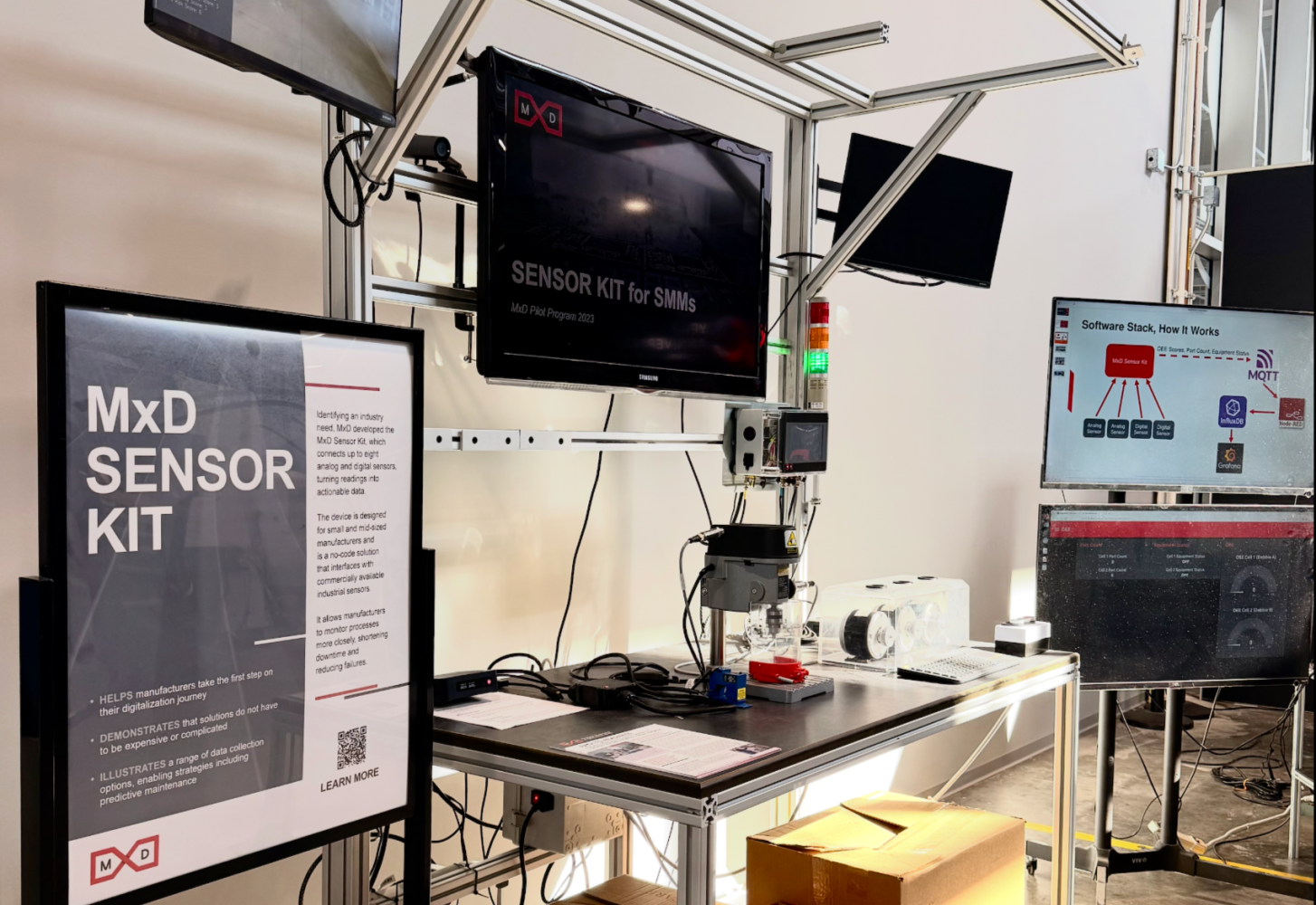
However, after attending the MxD Summit last week, I’ve begun to reconsider my perspective. During the conference I encountered examples of traditional manufacturing equipment being enhanced by collaboration with emergent technologies. For example, the MxD sensor kit connects up to eight commercially available analog and digital sensors, is designed for small and midsized manufacturers, and presents sensor readings as data. The demonstration dashboard showed equipment status, part counts, and overall equipment effectiveness (OEE). I found this particularly interesting because it demonstrated the potential to improve a system without completely replacing it and instead by listening to it again with sharper, better-tuned ears.
A conceptual illustration of the potential gap between individual and organizational productivity, inspired by Christophe Kolb’s session at the MxD Summit
For manufacturers without the labor or capital readily available to completely reimagine their processes, this sort of cross-generational integration could be a source of life or revival. This isn’t to imply that the process is completely frictionless, just that it offers a less abrasive head start to optimization. Examples like the sensor kit show us that modern data and insight analysis can help inform smarter decisions by helping identify performance bottlenecks, evaluating OEE, and supporting predictive maintenance of legacy equipment. This way, manufacturers can better understand what’s happening and make better-informed decisions before taking on the costs of change.
Picture this. Equipment-status data shows a machine stopping more frequently than expected, and a team chooses to investigate. After investigating the stops, they may change maintenance practices or discover another cause. In the end, one way to re-evaluate the changes in the system would be to compare downtime before and after the change.
This idea of incremental modernization is especially useful when paired with the idea that more or newer equipment doesn’t automatically translate into greater capacity. With new capabilities come new opportunities. Useful progress follows when people use those capabilities to address a pre-existing problem and can see whether the result is improvement.
‘Data’ is a buzzword that I’m sure by now we’ve all heard. Regardless of how you like yours packaged, one of the most important aspects of its utility is how it’s received. In order to ensure that we’re getting the most out of the data we’re harvesting, we must first try improving our processes of interpretation and implementation.
At the MxD Summit, I attended many breakout sessions about maximizing the utility of AI and addressing gaps in organizational productivity. My favorite, led by Christophe Kolb, raised a question that stayed with me:
“AI is speeding up your tasks, but is it speeding up your business?”
Who cares that AI can help you write your newsletters faster if it doesn’t actually augment the ease and efficiency of distributing them?
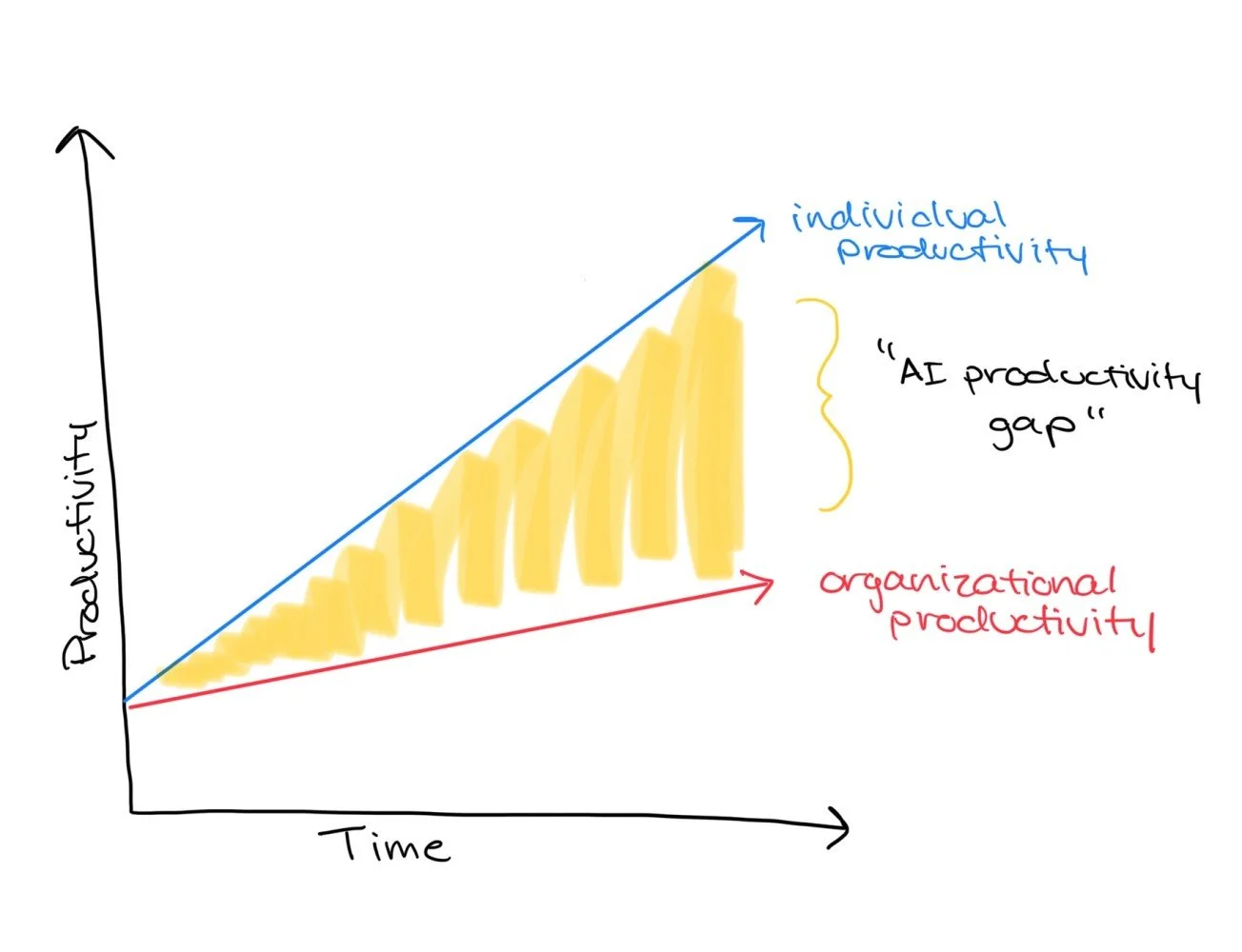
A conceptual illustration of the potential gap between individual and organizational productivity, inspired by Christophe Kolb’s session at the MxD Summit
The MxD sensor kit can make equipment information more accessible, but that doesn’t change operations. AI can help someone complete a task faster, but does that time saving improve the business as a whole? The time an employee may save by using AI to optimize one step of the process could be getting tossed right back at them through delays in approval or a disconnected process.
Though I used to imagine modernization as a bulldozer clearing away everything that came before it, I now see the value in taking a closer look before clearing the ground. Existing equipment and processes can tell us where a system succeeds, where it struggles, and where new technology could make the greatest difference.